Building high-performance teams is one of the greatest challenges leaders face.
Organizations invest significant time and money into leadership development, communication training, process improvements, and performance management. Yet many teams continue to experience the same frustrations.
Projects fall behind schedule.
At the same time, departments begin blaming one another.
As a result, expectations become unclear.
Even dedicated employees work hard but still produce inconsistent results.
When this happens, leaders often assume they have a people problem. They may believe employees need more motivation, better communication, or stronger accountability.
However, the real issue is often much simpler.
People often use the same words while assigning completely different meanings to them.
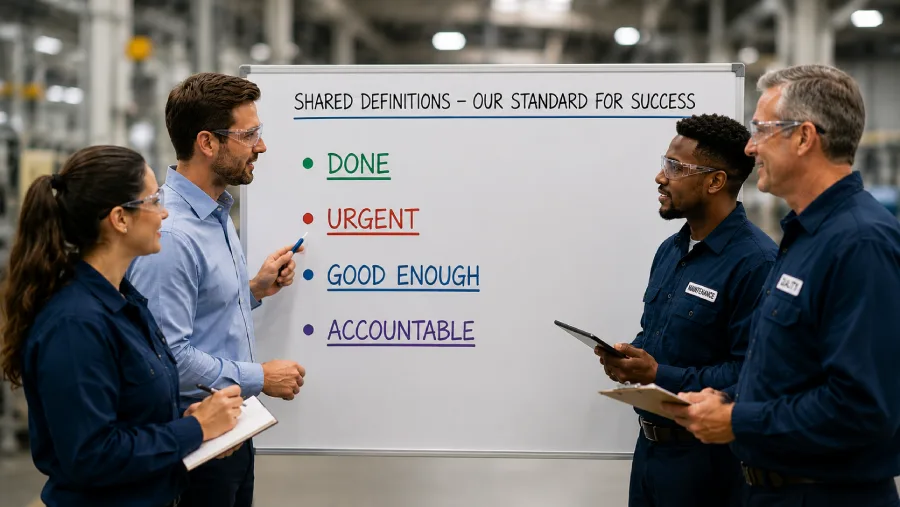
Words such as done, urgent, good enough, and accountable appear in almost every meeting, project update, shift handoff, and performance discussion. Although everyone uses these words, very few teams ever stop to define them.
That is where confusion begins.
One employee believes a task is complete while another believes significant work remains.
Meanwhile, supervisors often treat every request as urgent, while others reserve urgency for production stoppages.
Another department believes the work meets expectations while a different team believes it falls short.
Everyone believes they are correct.
Because according to their own definition, they are.
Throughout my 30 years leading manufacturing teams, I discovered that building high-performance teams begins with something many organizations overlook. In fact, building high-performance teams depends on creating shared definitions before work even begins.
When everyone understands success the same way, communication improves naturally, accountability becomes clearer, and teams perform more consistently.
Why Building High-Performance Teams Is Challenging
Every leader wants a team that communicates effectively, solves problems quickly, and consistently delivers results.
However, high-performance teams are not built simply because talented people work together.
High-performing teams are built when everyone understands what success looks like.
Unfortunately, many organizations assume that procedures automatically create alignment.
They do not.
Most workplaces already have policies, standard work, operating procedures, and checklists.
These documents explain what employees should do.
However, they often fail to define what success actually looks like.
As a result, employees can follow the correct process while producing completely different outcomes.
One department believes they delivered exactly what was requested.
The receiving department immediately identifies missing information or unfinished work.
Both teams become frustrated because both believe they met expectations.
Eventually, trust begins to erode.
Many leaders respond by adding more meetings, documentation, or oversight in an effort to solve the problem.
Although these actions may improve structure, they rarely solve the real issue.
Without shared definitions, even excellent processes can create confusion.
The Hidden Cost of Undefined Expectations
Undefined expectations quietly reduce team performance.
Initially, the problems appear small.
A deadline is misunderstood.
A project requires unnecessary rework.
A handoff takes longer than expected.
Employees spend time clarifying information that everyone assumed was already understood.
However, these small issues gradually become larger organizational problems.
Work is repeated.
Meetings become less productive.
Departments become defensive.
Leaders spend more time resolving misunderstandings than improving performance.
Furthermore, undefined expectations create unnecessary conflict.
When employees believe they have completed excellent work only to discover someone else expected something different, frustration grows quickly.
The conversation shifts away from improving the work and toward defending personal performance.
Often, the issue is not effort or attitude.
It is simply a difference in definition.
Fortunately, that is one of the easiest leadership problems to solve.
Why Building High-Performance Teams Requires Shared Definitions
High-performing teams do not leave important words open to interpretation.
Instead, they define them together.
When leaders create shared definitions, they eliminate assumptions before work begins.
Everyone understands the finish line.
They also understand priorities.
Ownership becomes clear across the team.
This creates greater consistency throughout the organization.
Departments communicate more effectively.
Projects move more smoothly.
Decision-making becomes faster.
Most importantly, trust begins to grow because expectations remain consistent regardless of who is leading the discussion.
Shared definitions are not simply communication tools.
They are leadership tools.
Define “Done” Before Work Begins
One of the most expensive undefined words in any organization is done.
Ask five different people what done means, and you may receive five different answers.
An engineer may consider a task done once the design has been completed.
A production supervisor may define done as successfully moving the product through production.
Meanwhile, a maintenance technician may not consider the work done until the equipment is operating normally again.
Each definition is reasonable.
However, each one creates a different finish line.
This is where unnecessary conflict begins.
One team proudly announces the work is complete.
The receiving team immediately identifies missing information, unresolved issues, or additional work.
Both believe they are right.
Performance is not the issue.
Instead, the real problem is the definition itself.
Instead of assuming everyone shares the same understanding, leaders should define done before work begins.
A strong definition should be measurable, specific, and easy to verify.
For example, instead of saying a process is complete when engineering finishes the design, the organization may define done as achieving target production rates for three consecutive shifts without engineering support.
Now everyone shares the same finish line.
The discussion moves away from opinions and toward agreed standards.
Define “Urgent” Before Everything Becomes Urgent
Few words lose their meaning faster than urgent.
In manufacturing, almost every request feels important.
Production schedules are tight.
Customers expect quick responses.
Equipment requires attention.
Quality concerns demand action.
Eventually, employees begin describing every request as urgent.
Unfortunately, when everything is urgent, nothing truly is.
The loudest request receives attention rather than the most important one.
Meanwhile, genuinely critical issues may wait.
High-performing teams prevent this by defining urgency according to operational impact rather than emotion.
For example:
Level 1 may represent a production stoppage or safety concern requiring immediate action.
Level 2 focuses on issues that may interrupt production later in the shift if they are not addressed.
Finally, Level 3 covers improvement opportunities that can be scheduled without disrupting current operations.
When urgency is defined this way, priorities become clearer.
Teams allocate resources more effectively.
Most importantly, employees maintain credibility because the word urgent retains its meaning.
Define “Good Enough” to Improve Team Performance
Another phrase leaders should define is good enough.
At first, this phrase can make people uncomfortable because it sounds like lowering standards.
However, defining good enough is not about accepting mediocre work. It is about creating consistency.
Every organization must balance quality, speed, safety, cost, and customer expectations. While each of these priorities is important, they cannot all be maximized at the same time.
Without a shared definition, employees make these decisions independently.
One employee spends extra hours perfecting details that customers may never notice.
Another focuses on speed and unintentionally overlooks something important.
Neither employee is trying to create problems.
They are simply working from different standards.
High-performing teams avoid this by clearly defining what acceptable performance looks like.
For recurring tasks, ask questions such as:
- What is the minimum standard that still meets customer expectations?
- What would exceed expectations?
- What would require rework?
When everyone understands the standard, decisions become more consistent. Employees spend less time second-guessing themselves, and leaders spend less time correcting avoidable mistakes.
Define Accountability Before Problems Occur
Few leadership words are misunderstood more than accountability.
In many organizations, accountability has become another word for blame.
A project falls behind.
A customer issue occurs.
A production target is missed.
The first question becomes:
“Who’s accountable?”
Unfortunately, this usually happens after the problem has already occurred.
True accountability begins much earlier.
It starts before the work begins by clearly defining ownership.
High-performing teams make sure every important project has someone responsible for the outcome, not just the individual tasks.
More importantly, that person understands when they are expected to raise concerns if something begins moving off track.
This changes accountability from a reactive conversation into a proactive one.
Employees become more willing to communicate risks early because they know leadership values transparency over blame.
As a result, problems become visible sooner, allowing the team to respond before they become major issues.
How Shared Definitions Help Build High-Performance Teams
Shared definitions improve much more than communication.
They improve alignment across the entire organization.
Departments begin working toward the same expectations.
Shift handoffs become smoother.
Projects move more efficiently.
Meetings become more productive because conversations focus on solutions instead of assumptions.
Furthermore, shared definitions strengthen trust.
People become more confident because expectations remain consistent regardless of who is leading the discussion.
This consistency is especially valuable in manufacturing environments where multiple departments and shifts depend on one another every day.
Without shared definitions, every handoff introduces uncertainty.
With shared definitions, every handoff reinforces clarity.
Ultimately, alignment is not created because people attend the same meeting.
Alignment is created because everyone leaves the meeting with the same understanding.
Questions Every Leader Should Ask
If your team continues to experience recurring frustration, start by looking beneath the problem.
Think about one challenge your team faces regularly.
Perhaps projects are consistently delayed.
Maybe departments struggle during handoffs.
Maybe the same disagreement appears in every production meeting.
Now ask yourself four simple questions.
Would this problem still exist if everyone shared the same definition of done?
How would priorities change if everyone shared the same definition of urgent?
What would improve if everyone defined good enough the same way?
Could ownership become clearer if everyone shared the same definition of accountable?
If the answer is no, then the issue may not be a people problem.
It may not even be a process problem.
It may simply be a definitions problem.
Fortunately, that is something every leadership team can improve.
Leadership Is the Foundation of Building High-Performance Teams
Building high-performance teams does not begin with more meetings, more policies, or more procedures.
It begins with leadership.
Strong leaders create clarity before confusion appears.
They define success before measuring performance.
Next, they establish ownership before assigning responsibility.
Most importantly, effective leaders ensure people understand the same message in the same way.
That is exactly what shared definitions accomplish.
When leaders take time to define words such as done, urgent, good enough, and accountable, communication improves naturally.
Decision-making becomes faster.
Trust becomes stronger.
Accountability becomes healthier.
Performance becomes more consistent.
Although every organization is different, building high-performance teams always starts with clarity. When leaders define expectations together, they eliminate confusion before it affects performance.
Together, these practices create the foundation for stronger leadership, healthier workplace relationships, and sustainable organizational success.
After more than 30 years in manufacturing leadership, I have learned that the highest-performing teams are rarely the ones with the most talented people.
They are the teams that invest time in creating shared understanding before the pressure begins.
Continue Your Leadership Journey
At Soaring Leadership, we’re proud to have Joyce leading the way. With more than 30 years of real-world leadership and manufacturing experience, she has a unique ability to connect with everyone; from frontline employees to executives. Joyce’s practical, people-first approach has helped organizations like Gay Lea, Lou’s Kitchen, PepsiCo, Made Rite Meat Products, Maximum Seafood, Premium Brands, and many others build stronger leaders, healthier cultures, and better operational performance.
If you’re looking to strengthen leadership, improve communication, boost engagement, or elevate performance on your team, we’d love to support you. Soaring Leadership offers a full range of customized programs, including:
- Live Leadership Training & Workshops; fully tailored to your goals
- Free Leadership Essentials Course
- Premium Membership (Full Course Library Access)
- Personalized Coaching with Joyce
If you’re ready to explore how we can support your leaders and elevate your culture, you can book a free consultation with Joyce anytime:
Book a Free Consultation
We’d love to help your team grow.
Find us on LinkedIn.