It might be:
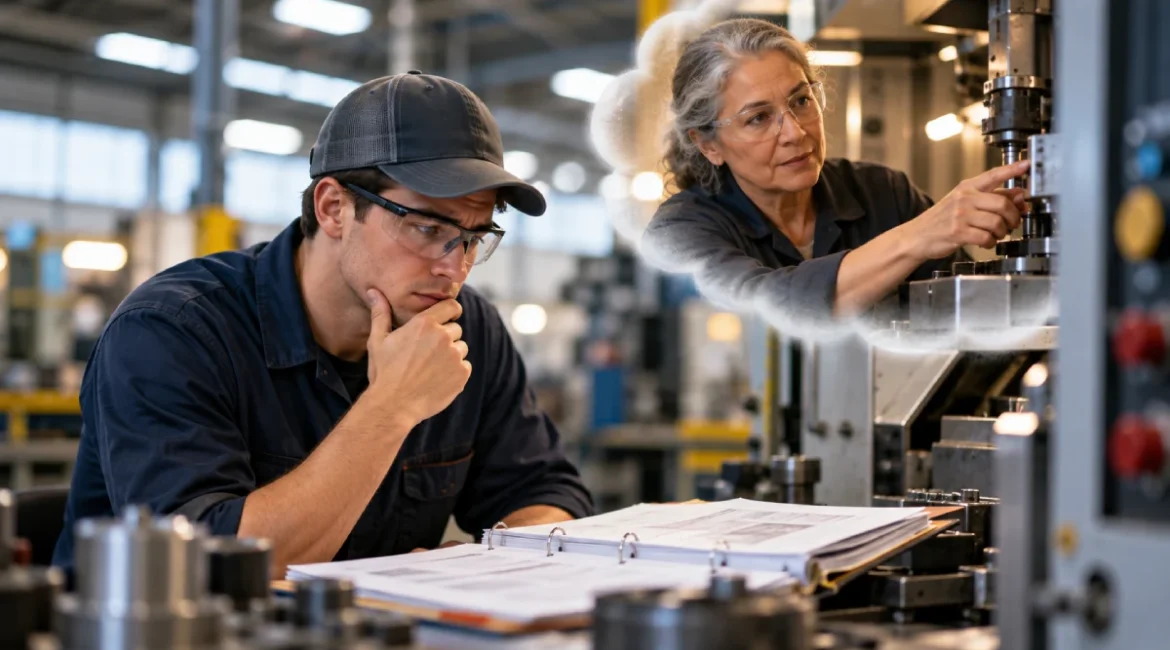
“We’ll ask Maria when she gets back.”
Maria has been running that line for 20 years. She knows the sound it makes before a problem appears, what to check first, and which adjustment could make things worse.
But today, she isn’t there.
A newer employee notices something unusual and checks the procedure. It explains what the machine should do, but it doesn’t contain the experience Maria has built over two decades.
So he waits.
The knowledge exists. He just can’t reach it when he needs it.
That’s the challenge behind manufacturing knowledge transfer.
When Experience Lives in Someone’s Head
Some of the most valuable knowledge in manufacturing is never fully captured in a manual.
It develops through years of solving problems, noticing patterns, making mistakes, and learning what works.
That creates a risk.
What happens when your most experienced operator retires? How does the night shift access what your day-shift expert knows? Where does someone look when the procedure doesn’t quite match the situation in front of them?
Suddenly, knowledge isn’t just a training issue.
It’s an operational one.
Could AI Help Without Doing the Thinking for Us?
AI seems like an obvious solution, but there’s another side to consider.
According to the IBM Institute for Business Value’s 2026 global study, Designing the Thinking Organization, 60% of employees surveyed said skill erosion directly affects them, with critical thinking among the skills employees reported as being negatively affected.¹
That’s an important warning.
The goal shouldn’t be to give employees an AI tool that thinks for them.
Instead, what if AI could help people find the right knowledge faster, understand it, and learn from it?
What If Maria’s Experience Became Searchable?
That’s the idea behind Tribal IQ™.
Imagine bringing together your approved procedures, manuals, videos, past solutions, and the experience of the people who know the work best.
When an employee has a question, they can ask Tribal IQ and access relevant company knowledge, including the sources behind the answer.
Now Maria doesn’t always have to be standing beside them.
More importantly, when she eventually retires, her 20 years of experience don’t simply walk out the door.
They become part of what the next person can learn from.
An Answer Can Become a Learning Moment
Technology can surface the knowledge.
Leadership determines what happens next.
After an employee solves a problem, a supervisor can ask:
“What did you learn?”
Then:
“What would you look for next time?”
Those simple questions move someone from getting an answer to building judgment.
That’s where AI and leadership can work well together: AI helps people reach knowledge, while leaders help people grow from it.
Who Is Your Maria?
Think about your workplace.
Who gets called when nobody else knows what to do? Who recognizes the warning signs others miss? Whose experience would be incredibly difficult to replace?
Now consider the question that matters:
If that person wasn’t there tomorrow, how much of what they know could your team still access?
If the answer makes you uncomfortable, it may be time to start capturing that knowledge.
Explore Tribal IQ™ or book a Clarity Session with Soaring Leadership to discuss where knowledge may be at risk in your organization.
You can also explore our Live Leadership Training, Online Learning Academy, and Hey Joyce for additional ways to build stronger leaders and more capable teams.
Your experienced people spent years building what they know. Don’t wait until they’re gone to realize how much you needed it.
¹ IBM Institute for Business Value, Designing the Thinking Organization, 2026.